Monday,November 28, Agra
Now that we were safely at our destination, we were taken for a quick bite to eat at Hotel Riaz. This was the first time we were out and about on our own, with just the driver dropping us off and waiting for us outside the restaurant. Pastor John was going to meet us after we had eaten.

With great expectation, and a bit of glee, we perused the menu and deliberated over what to order. All of us were dedicated foodies, and the chance to experience real Indian food, and try new things was very exciting. I, personally, was battling a headache, and tend to be more compliant, so I left the ordering decisions to the others. Soon we were dining on some spicy, delicious food - Tikka chicken which was roasted in a Tandoor, along with some chick-pea curry and garlic naan bread. The Tikka chicken came with some sliced red onions and cucumber and tomatoes on the side, which complimented the spicy hot seasoning quite nicely. Without a thought to the threat of food-borne-illnesses (more to come on that issue...) we gobbled down the amazing food, paid our bill and were joined by Pastor John to head to the Dalit school.
Dalit is the name for the untouchable caste, of which there are approximately 160 million residing across India. Traditionally, they are the lowest people in Indian culture, such that they may not even share gods with other Hindus - there have been gods "made" just for the Dalit caste. What better people to reach out to and touch with the saving grace provided in the Gospel.
We drove along some very rough roads, and noticed far more livestock - goats, pigs, cows, water buffalo, horses and even a camel or two along the way. Eventually, we came to what appeared to be a new developing community. There were plotted out lots with bricks lining small areas, but no electricity or other modern conveniences that we are familiar with. We saw a medium sized apartment, and were told that it was a government-made building for the Dalits. However, they have it so ingrained in their mindset that they deserve nothing but to be the bottom, the least of society and beggars for their lifetime; so many of the Dalits would take their apartments and sell them for the monetary gain, which would help them in the short term, but leave them on the streets and in slums for the long-term.
This school was one of the newer ministries and included a sewing school for Dalit women, to learn a skill so they could have the ability to provide some income and be deemed more "valuable". With several honks of the horn outside, a gate opened and we drove into the complex. Now a little more seasoned in the experience of meeting new people, we were excited to get out of the vehicle and get started.
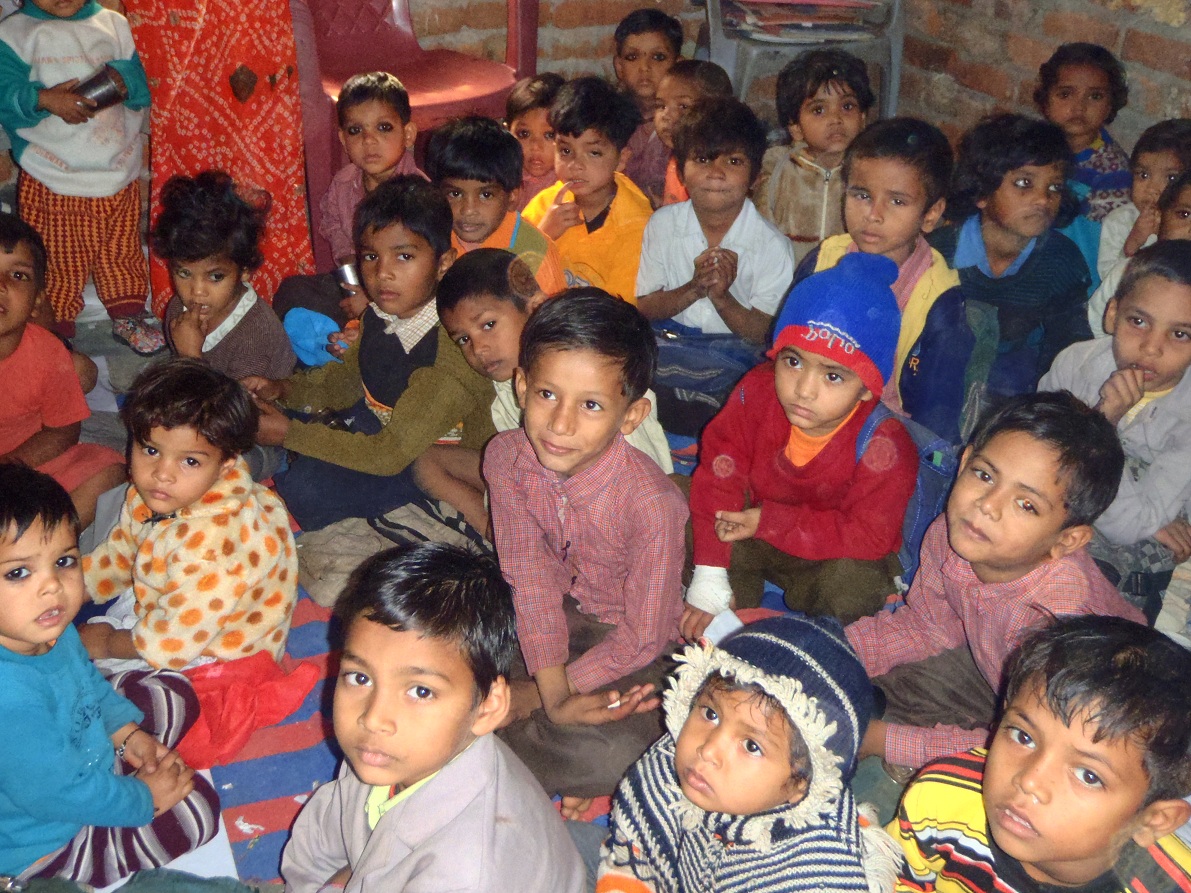
Classes were in session with 4 different levels, arranged both by age and ability. The youngest class, which seemed to have children who must have been barely 3 years old, was seated outside in the courtyard. The children were distracted by our presence and stared up at us with frightened brown eyes. We learned that most of these children had probably never met a white person before, so it was no wonder that they were so concerned! Again, I was impressed at the children's ability to pay attention and remain seated so respectfully. Not only that, but their teachers were just young woman (who looked to be in their late teens or early twenties). We found out that some of the teachers within the schools we had visited were former attendees of the schools at which they now taught! They were investing back into the ministry that had changed their lives as children... an incredible cycle of success breeding more success for the future.

We spent some time in each classroom, listening to the children as they recited memory work. One of the classes was simply a large room with a divider cutting it in half so two groups could make use of the room. Despite the potential distraction of another class carrying on right next to them, the kids remained focused and committed. It was so easy to become impressed with these kids. They were deemed by their society as outcasts, but had been given a vision and new perspective that allowed them to seek more for their lives and their future.
 Our favorite class was the youngest one (the children seated outdoors) and when we "toured" their class, their teachers pressed the children to show us what they had been learning. One of they little boys couldn't stop staring at us, and he looked like he was about to cry. Another one was encouraged to stand up and recite something, but stood silent and frightened, with her lower lip trembling and eyes tearing up. Kindra and I, with our mother's hearts melting, squatted down in front of the class and smiled and tried to make ourselves look as welcoming as possible. We were invited to pray for the children, and afterwards, we couldn't bear to leave them without somehow bridging the gap so we attempted to sing a song for the kids. Alas... they remained fairly statuesque, only a couple of them warming up to us and granting us a timid smile! They were so sweet... so precious, and knowing that they were labeled by their society as "untouchable" made me want to gather each of them into my arms, kissing them and telling them that they were loved.
The time came for the children to be given their meal of bread and buffalo milk, as they were going to be dismissed and the women from the sewing school would be arriving. We blessed the food and the children sat on the floor and patiently waited for us to hand out the bread and milk. The room was quiet and calm, as the children intently gobbled up every nibble of bread and enjoyed every swallow of warm buffalo milk. Since we had a short time left to spend with the children once they were done eating, we had them line up in a crowd outside so we could take their picture. From the smallest to the tallest, I looked at each child and stood in awe of their worth. The lives of these children were so evidently transformed by the power of the gospel - not empty, meaningless words that were pronounced from a fancy pulpit in some western-hemisphere church - but the gospel in action, administered with love and compassion.

Some children were picked up by their mothers, and others had only the company of their sibling as they returned to the dusty roads to walk to their homes. I stepped outside of the gate and watched some young children as they wandered away from the school. The world seemed so large, dirty and unfriendly; ready to swallow up these young souls. It made me realize what a light this school was - a place of hope and peace that did not merely provide food, clothing and education, but one that fed their souls and gave life to their spirits. Everywhere I looked, I saw dirt, garbage and a world in disarray... behind me, within the walls of the school was a haven of hope.


The next part of our day involved the sewing school. Originally, these schools were created to give women the opportunity to earn money, making them more valuable as brides. As I explained in a previous posting, bride burnings still occurred and authorities often turned a blind eye to it's existence. Young women, and some older women began to arrive, and they dismantled the children's classroom and transformed it into the sewing school. And by that, I mean they took the divider from the largest room and pushed it back against the wall so there would be more space.
I have always thought of Indian women as very beautiful, in their colorful saris and punjab outfits - and as I watched the women coming in to the class, I wondered about each of their backgrounds - what sort of world had each of them grown up in, and what did their future hold? We were told that we would be involved in the graduation ceremony, and the four of us were once again thrown off-guard, thinking "How on earth do we conduct ourselves and make this event special for these women?...surely they will know that we are inexperienced, awkward and ill-prepared to preform such an incredible task!"
Once the women were all seated and arranged in rows on the floor, the ceremony began. Pastor John began by greeting them and introducing us (in Hindi) and then were were told to go and inspect their sewing before the certificates would be awarded. I took a deep breath and waded into the crowd, starting somewhere in the middle. I found a row of 3 young women, who shyly smiled at me in anticipation. I squatted down and was joined by an interpreter and I asked the first girl if I could look at her book. She had a large scrapbook of miniature shirts, aprons, dresses and pants which displayed the skills she had learned - different types of stitching and making pleats and buttonholes. I smiled and acknowledged the obviously tedious work and commented on her fine stitches. She looked very pleased at my words and I continued through her book, ooh-ing and awing at her designs.
At one point I tried to explain how their practice work remind me of my daughter's Barbie clothes, and the translator spoke to the girls, until they smiled and nodded in understanding. It made me wonder if most of them never had toys or dolls, and that was why it took them a few moments to understand my comparison. After viewing each girls work, they would then show me the larger project they had completed - often an entire woman's outfit. Some of them were even wearing the outfits they had created with decorative designs on the neckline. It wasn't difficult to compliment the incredible work they had done!
One of the girls really stood out to me, with her long black hair and expressive eyes. She had such a sweet demeanor and I could tell she was soaking up every word of compliment that I gave as I examined her work. She showed me a beautiful brown tunic that she had made and I looked her in the eyes and said with confidence: "I would buy this if it was at a store - it is beautiful!" She looked down with modesty, her hand covering her instant smile at my generous praise. I continued on to the next girl and a couple minutes later, the girl with the doe-eyes was holding out the brown tunic and gesturing that she wanted me to take it.
She spoke to me, and the interpreter told me that she wanted to give me the tunic as a gift. I was so surprised at her generosity, and felt bad for taking away something that she could most certainly sell and make a profit with. From what we knew, these girls would save up whatever money they had to buy scraps with which the practice their sewing skills. I told her that I was very grateful for her offer, but that I couldn't take it. She looked all the more determined to give it to me, but it just felt so wrong! My attention was diverted elsewhere as we were hurrying to observe all of the student's work before our time ran out.
Once we had examined all of the girls' work, it was time to hand out the certificates. We were called up to the front where there was a stage area, and before we could begin, one of the girls asked to say something to us. She stood up, and with a translator, she told us how in the school, they had learned that although they might not have very much, that God wanted them to be generous and to give. They learned that they could be givers, and even in their newly learned ability to sew, they could see it as a way to bless people - not to merely better their own lives. She wanted to give away one of the tunics she had made to one of us. She came up, and judging our sizes, decided that her offering would be most likely fit me rather than Kindra. As I thanked her and smiled, in the back of my mind I began to feel that maybe I had responded to the first girl wrongly. I had felt so guilty to take something from someone whom I knew to be extremely poor compared to myself, but I was preventing her from operating in the gift of generosity. No matter what your stature, be it rich or poor, all people can exhibit either greed or generosity.
We were asked to speak a brief word of congratulation/encouragement to the girls and soon the women's names were being called and we would shake their hand and give them their graduation certificate. It was such a triumphant moment in our trip as we handed out these formal slips of paper that represented dignity and hope to each of the women. It felt that we were empowering them to go forth and have success - they were no longer destined to be the lowest of the low, but now had the opportunity to improve both their lives and the lives of their loved ones.
Following the ceremony, we headed out into the courtyard to take a group picture of the women holding their certificates. Afterwards, the young woman with the brown tunic came up to Kindra and offered her the tunic that I had felt unable to accept. After the previous display of generosity that we had seen before the ceremony, it wasn't as difficult to receive this precious gift, knowing that it was more about the attitude of giving than it was about the gift itself. I was glad that this young lady was able to fulfill the urging in her heart, and I knew in the future I would hopefully respond better if met with a similar situation.
 Later that evening in our hotel room, as we prepared for the special church service in Agra, we were startled to hear a knock and laughter at our door. We opened it up to Steve and Kindra who were in hysterics over the state of Kindra who was attempting to put on the brown tunic. Sadly, it was a bit smaller than it looked, and Kindra was awkwardly posed with her arms and head in the tunic, but unable to pull it past her shoulders. We all had a laugh at her uncomfortable position, and I offered her the other tunic which I had also been unable to wear due to it's small size. Fortunately, the one I was given fit Kindra, and she offered the brown tunic to me to give to my eldest daughter. So in the end, I was pleasantly surprised that I would indeed get to receive the gift that had first been offered me, although it would instead be worn by my daughter. It is most certainly one of the most precious souvenirs that I have ever been privileged to take home from a trip. It's amazing how much I can learn about generosity from those "less fortunate" than myself.
Now that we were safely at our destination, we were taken for a quick bite to eat at Hotel Riaz. This was the first time we were out and about on our own, with just the driver dropping us off and waiting for us outside the restaurant. Pastor John was going to meet us after we had eaten.

 |
| Notice the dirt on the straws... were they recycled? |
With great expectation, and a bit of glee, we perused the menu and deliberated over what to order. All of us were dedicated foodies, and the chance to experience real Indian food, and try new things was very exciting. I, personally, was battling a headache, and tend to be more compliant, so I left the ordering decisions to the others. Soon we were dining on some spicy, delicious food - Tikka chicken which was roasted in a Tandoor, along with some chick-pea curry and garlic naan bread. The Tikka chicken came with some sliced red onions and cucumber and tomatoes on the side, which complimented the spicy hot seasoning quite nicely. Without a thought to the threat of food-borne-illnesses (more to come on that issue...) we gobbled down the amazing food, paid our bill and were joined by Pastor John to head to the Dalit school.
 | |
| Tikka Chicken... so freakin' amazing! |
 | |
| Outside the Dalit School |
We drove along some very rough roads, and noticed far more livestock - goats, pigs, cows, water buffalo, horses and even a camel or two along the way. Eventually, we came to what appeared to be a new developing community. There were plotted out lots with bricks lining small areas, but no electricity or other modern conveniences that we are familiar with. We saw a medium sized apartment, and were told that it was a government-made building for the Dalits. However, they have it so ingrained in their mindset that they deserve nothing but to be the bottom, the least of society and beggars for their lifetime; so many of the Dalits would take their apartments and sell them for the monetary gain, which would help them in the short term, but leave them on the streets and in slums for the long-term.
This school was one of the newer ministries and included a sewing school for Dalit women, to learn a skill so they could have the ability to provide some income and be deemed more "valuable". With several honks of the horn outside, a gate opened and we drove into the complex. Now a little more seasoned in the experience of meeting new people, we were excited to get out of the vehicle and get started.
Classes were in session with 4 different levels, arranged both by age and ability. The youngest class, which seemed to have children who must have been barely 3 years old, was seated outside in the courtyard. The children were distracted by our presence and stared up at us with frightened brown eyes. We learned that most of these children had probably never met a white person before, so it was no wonder that they were so concerned! Again, I was impressed at the children's ability to pay attention and remain seated so respectfully. Not only that, but their teachers were just young woman (who looked to be in their late teens or early twenties). We found out that some of the teachers within the schools we had visited were former attendees of the schools at which they now taught! They were investing back into the ministry that had changed their lives as children... an incredible cycle of success breeding more success for the future.

We spent some time in each classroom, listening to the children as they recited memory work. One of the classes was simply a large room with a divider cutting it in half so two groups could make use of the room. Despite the potential distraction of another class carrying on right next to them, the kids remained focused and committed. It was so easy to become impressed with these kids. They were deemed by their society as outcasts, but had been given a vision and new perspective that allowed them to seek more for their lives and their future.
 Our favorite class was the youngest one (the children seated outdoors) and when we "toured" their class, their teachers pressed the children to show us what they had been learning. One of they little boys couldn't stop staring at us, and he looked like he was about to cry. Another one was encouraged to stand up and recite something, but stood silent and frightened, with her lower lip trembling and eyes tearing up. Kindra and I, with our mother's hearts melting, squatted down in front of the class and smiled and tried to make ourselves look as welcoming as possible. We were invited to pray for the children, and afterwards, we couldn't bear to leave them without somehow bridging the gap so we attempted to sing a song for the kids. Alas... they remained fairly statuesque, only a couple of them warming up to us and granting us a timid smile! They were so sweet... so precious, and knowing that they were labeled by their society as "untouchable" made me want to gather each of them into my arms, kissing them and telling them that they were loved.
The time came for the children to be given their meal of bread and buffalo milk, as they were going to be dismissed and the women from the sewing school would be arriving. We blessed the food and the children sat on the floor and patiently waited for us to hand out the bread and milk. The room was quiet and calm, as the children intently gobbled up every nibble of bread and enjoyed every swallow of warm buffalo milk. Since we had a short time left to spend with the children once they were done eating, we had them line up in a crowd outside so we could take their picture. From the smallest to the tallest, I looked at each child and stood in awe of their worth. The lives of these children were so evidently transformed by the power of the gospel - not empty, meaningless words that were pronounced from a fancy pulpit in some western-hemisphere church - but the gospel in action, administered with love and compassion.

Some children were picked up by their mothers, and others had only the company of their sibling as they returned to the dusty roads to walk to their homes. I stepped outside of the gate and watched some young children as they wandered away from the school. The world seemed so large, dirty and unfriendly; ready to swallow up these young souls. It made me realize what a light this school was - a place of hope and peace that did not merely provide food, clothing and education, but one that fed their souls and gave life to their spirits. Everywhere I looked, I saw dirt, garbage and a world in disarray... behind me, within the walls of the school was a haven of hope.


The next part of our day involved the sewing school. Originally, these schools were created to give women the opportunity to earn money, making them more valuable as brides. As I explained in a previous posting, bride burnings still occurred and authorities often turned a blind eye to it's existence. Young women, and some older women began to arrive, and they dismantled the children's classroom and transformed it into the sewing school. And by that, I mean they took the divider from the largest room and pushed it back against the wall so there would be more space.
I have always thought of Indian women as very beautiful, in their colorful saris and punjab outfits - and as I watched the women coming in to the class, I wondered about each of their backgrounds - what sort of world had each of them grown up in, and what did their future hold? We were told that we would be involved in the graduation ceremony, and the four of us were once again thrown off-guard, thinking "How on earth do we conduct ourselves and make this event special for these women?...surely they will know that we are inexperienced, awkward and ill-prepared to preform such an incredible task!"
 |
| Dresses designed by the girls |
At one point I tried to explain how their practice work remind me of my daughter's Barbie clothes, and the translator spoke to the girls, until they smiled and nodded in understanding. It made me wonder if most of them never had toys or dolls, and that was why it took them a few moments to understand my comparison. After viewing each girls work, they would then show me the larger project they had completed - often an entire woman's outfit. Some of them were even wearing the outfits they had created with decorative designs on the neckline. It wasn't difficult to compliment the incredible work they had done!
One of the girls really stood out to me, with her long black hair and expressive eyes. She had such a sweet demeanor and I could tell she was soaking up every word of compliment that I gave as I examined her work. She showed me a beautiful brown tunic that she had made and I looked her in the eyes and said with confidence: "I would buy this if it was at a store - it is beautiful!" She looked down with modesty, her hand covering her instant smile at my generous praise. I continued on to the next girl and a couple minutes later, the girl with the doe-eyes was holding out the brown tunic and gesturing that she wanted me to take it.
She spoke to me, and the interpreter told me that she wanted to give me the tunic as a gift. I was so surprised at her generosity, and felt bad for taking away something that she could most certainly sell and make a profit with. From what we knew, these girls would save up whatever money they had to buy scraps with which the practice their sewing skills. I told her that I was very grateful for her offer, but that I couldn't take it. She looked all the more determined to give it to me, but it just felt so wrong! My attention was diverted elsewhere as we were hurrying to observe all of the student's work before our time ran out.
Once we had examined all of the girls' work, it was time to hand out the certificates. We were called up to the front where there was a stage area, and before we could begin, one of the girls asked to say something to us. She stood up, and with a translator, she told us how in the school, they had learned that although they might not have very much, that God wanted them to be generous and to give. They learned that they could be givers, and even in their newly learned ability to sew, they could see it as a way to bless people - not to merely better their own lives. She wanted to give away one of the tunics she had made to one of us. She came up, and judging our sizes, decided that her offering would be most likely fit me rather than Kindra. As I thanked her and smiled, in the back of my mind I began to feel that maybe I had responded to the first girl wrongly. I had felt so guilty to take something from someone whom I knew to be extremely poor compared to myself, but I was preventing her from operating in the gift of generosity. No matter what your stature, be it rich or poor, all people can exhibit either greed or generosity.
 |
| Speaking to the sewing school girls |
We were asked to speak a brief word of congratulation/encouragement to the girls and soon the women's names were being called and we would shake their hand and give them their graduation certificate. It was such a triumphant moment in our trip as we handed out these formal slips of paper that represented dignity and hope to each of the women. It felt that we were empowering them to go forth and have success - they were no longer destined to be the lowest of the low, but now had the opportunity to improve both their lives and the lives of their loved ones.
Following the ceremony, we headed out into the courtyard to take a group picture of the women holding their certificates. Afterwards, the young woman with the brown tunic came up to Kindra and offered her the tunic that I had felt unable to accept. After the previous display of generosity that we had seen before the ceremony, it wasn't as difficult to receive this precious gift, knowing that it was more about the attitude of giving than it was about the gift itself. I was glad that this young lady was able to fulfill the urging in her heart, and I knew in the future I would hopefully respond better if met with a similar situation.
 |
| The Graduates |